Restriction
Analysis
Restriction analysis is to identify restriction mapping sites in DNA sequences using appropriate enzyme sets and enzyme filtering criteria as per specific experimental requirements.
How SimVector Software Performs Restriction Enzyme Analysis?
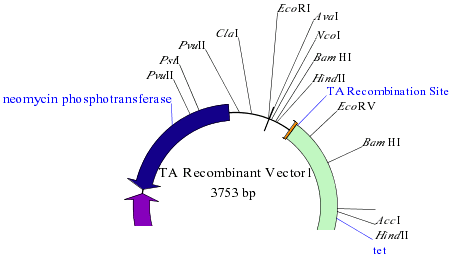
SimVector performs restriction analysis using a comprehensive database of over 1000 of restriction enzymes. SimVector analyzes and maps DNA sequences. You can perform restriction enzyme analysis on complete sequences as well as on fragments by specifying a range. The results of the restriction enzyme analysis are mapped on the circular or linear vectors, displaying the positions of restriction enzyme cleavage sites. Researchers can use SimVector for single or multiple enzyme analysis of linear or circular DNA. The input sequences can be uploaded from file, pasted or retrieved from NCBI link and are analyzed with respect to parameters set by the user.
How SimVector Represents Restriction Enzyme Cut Sites?
Web-savvy SimVector always displays only the latest information on any restriction enzyme. It allows the user to locate restriction enzyme sites on the DNA sequence and filter the results to display unique cutters, non cutting enzymes, or digestion sites within a defined region. It allows researcher to define custom enzymes or to create custom enzyme sets. Researcher can use commercially available restriction enzyme sets or define custom restriction enzyme sets. A custom enzyme set can be created from any available set by property filtering, by manually adding enzymes or by modifying an existing set by adding or removing enzymes. Restriction enzymes can be filtered from the enzyme set either by their properties such as recognition site and overhang types, or by selecting the enzymes manually. The search can be limited to enzymes that cut only within a sequence range and also by specifying their cut frequency.
Related Definitions
Restriction
Enzyme
Restriction enzymes are bacterial enzymes which form a part of the restriction modification defense mechanism of bacteria against foreign DNA. They can recognize specific oligonucleotide sequences, make double stranded nick and generate unique fragments of a DNA molecule. By the nature of their controllable, predictable, infrequent and site specific cleavage of DNA, restriction endonucleases have proved to be useful as a tool in dissecting, analyzing and reconfiguring genetic information at the molecular level. Bacteria contain over 400 such enzymes that recognize and cut more than 100 different DNA sequences.
Restriction
Enzyme Cut Sites (Recognition Site) Restriction enzyme cut site or recognition site is a specific sequence of DNA at which a particular restriction enzyme cuts the DNA. Some restriction sites may occur frequently in DNA and some may occur much less frequently. |